Synopsis – Why I Was Wrong About AI (And the 4 Tools That Proved It)
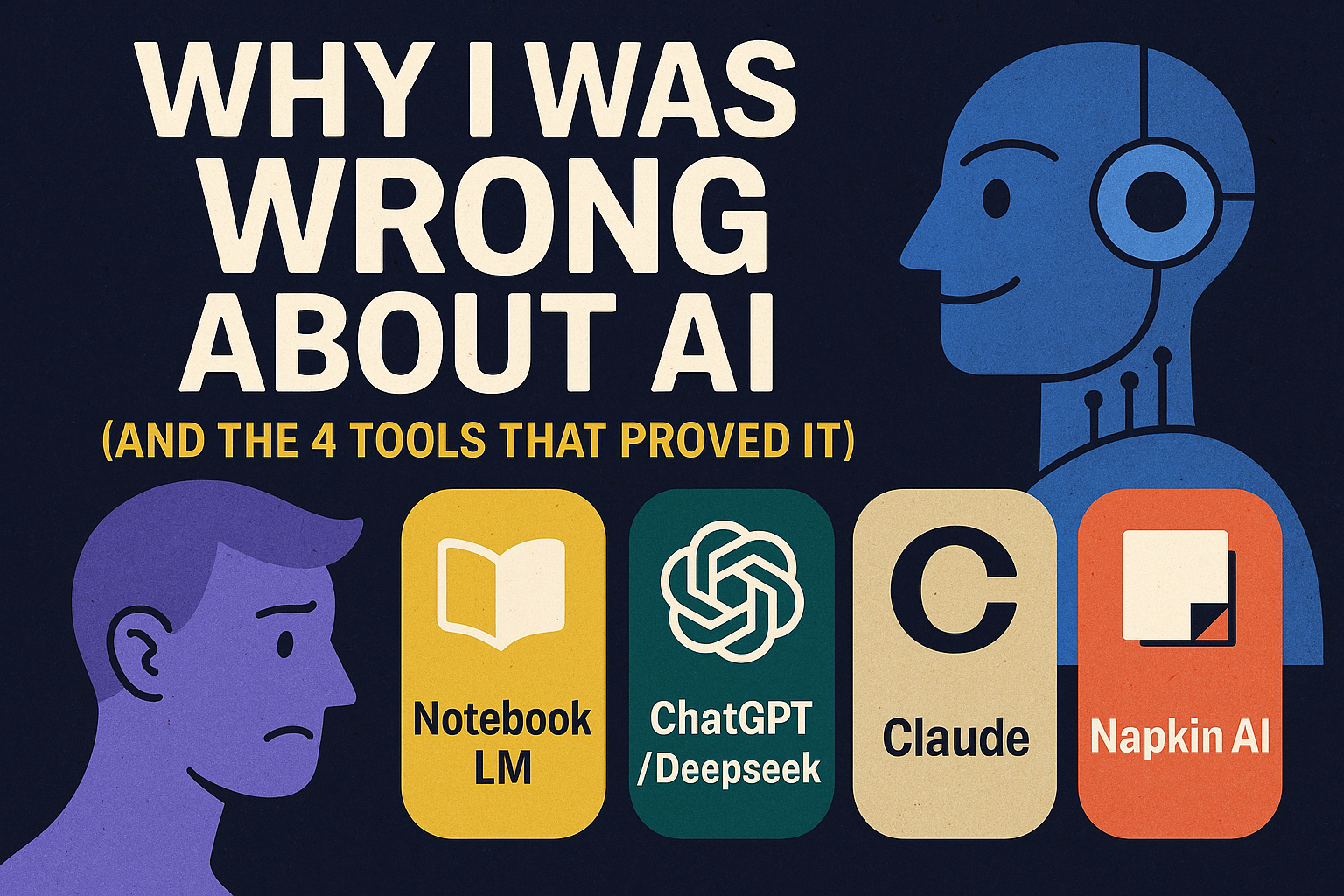
- 4 AI Tools I use the most
- NotebookLM
- Chat GPT / Deepseek
- Claude
- Napkin AI
- My Journey from Resisting AI to Embracing it

I once feared the idea of artificial intelligence in our day-to-day life. As someone whose entire career has revolved around content, the possibility that a program could effectively eliminate my role in the professional ecosystem terrified me. For that reason, I was hesitant, resistant, and dismissive of AI’s potential—overlooking it for nearly 90% of the time since its inception in 2022. I was intrigued by its capabilities, but my primal fear of being replaced or sidelined kept me from experimenting with it.
Now that I’ve begun incorporating AI into my daily and professional life—even if just 0.1% per day—I acknowledge that my fear was misplaced. Primarily because what I bring to my profession cannot be replicated by any artificial or sentient being in this universe: my perspective. It’s unique to me, and that realization has led me to achieve great things in my work. Though I still don’t fully leverage AI—mostly due to lack of practice and half-hearted attempts at integrating it—I’ve made exponential progress.
Here are the AI tools I use most frequently, ranked in order of usage:
1. DeepSeek/ChatGPT
Until DeepSeek emerged, ChatGPT was my go-to for countless tasks. I’ve used it to:
- Clean YouTube transcriptions
- Navigate backend editor tools
- Improve my grammar
- Design logos and kits for Football Manager 2024
- Assist with color schemes, fonts, and other details for my personal website
- Serve as a dictionary and thesaurus
- Create Excel formulas for turning my life into an RPG game
- Revamp my resume and LinkedIn profile
- Edit personal blog posts
And there are probably a hundred more use cases I’m forgetting. But both GPT and Deepseek are tools I have in my arsenal to make the most of my time and efforts.
2. NotebookLM
This has been a game-changer for extracting insights from YouTube videos and websites. I listen to many interviews, and before, if I found useful information, I’d manually jot it down like a lecture—a process that, while enjoyable, felt tedious. With hundreds of videos I want to absorb, taking physical notes for each would be overwhelming, requiring multiple listens to capture key points. NotebookLM outsources note-taking; I simply listen, then review the AI-generated summary, saving time and speeding up my learning.
3. Claude
I’m least familiar with Claude, but from my limited experience, it feels like the best blend of DeepSeek/ChatGPT and NotebookLM. It offers four response templates, giving me control over the tone and style of answers. It also processes text blocks or summaries from other AI bots to refine outputs. So far, I’ve mainly used Claude to condense long texts into digestible chunks. I’ll share more use cases as I explore further.
4. Napkin AI
This is one tool I don’t use daily. But it’s a tool that I highly recommend to anyone employed in any sector of knowledge work or students who want a creative and visual edge in their learning practices. It’s a simple, highly effective tool that will create visuals for any information provided. The visual for this article was provided by Napkin AI, and I’d highly recommend you to try this at least once.
I plan to add more tools to my arsenal, but that’ll happen in due time.